
The Australasian New Car Assessment Program says the adoption of autonomous emergency braking is the highest it’s ever been.
In the last four years AEB has grown to populate 60% of new car models currently on sale today as a standard feature, up from just 18% in 2017 and only 3% in 2015.
ANCAP reveals over 40,000 new cars entered the national road network fleet in September with AEB fitted.
There are still 13% of new car models currently on sale which do not offer AEB as standard, which ANCAP chief executive James Goodwin (right) says is a sign of progress.
“This is a significant milestone for the industry and the marketplace, with supply and demand working together to provide positive safety outcomes,” he says.
“A key role for ANCAP is to educate the community on the benefits of AEB, and in parallel, encourage vehicle brands to include it as standard across model ranges and price points,” he explains.
ANCAP also praises the market’s OEM brands for finally putting AEB within reach of regular buyers, where once safety tech was an optional extra or standard on expensive luxury models.
“Some of our most popular and most affordable models – the Toyota Corolla, Mazda 3 and Kia Cerato – and the highest selling light commercial vehicles – the Ford Ranger and Toyota Hilux – all include AEB as standard,” he adds.
Nunawading Toyota sales manager Stanley Chan says the fitment of AEB and like safety systems are a welcome inclusion, and suggests customers aren’t asking as many questions about it as one might think.

“Most of our customers now want all the features available as standard, including AEB, pre-collision features and so on,” he tells AutoTalk.
“Sometimes people ask about them but they often do a lot of research anyway, so they usually know how it works already – but there are still some who do ask what those features do,” Chan explains.
“Of course some people know nothing and we have to explain, but it’s difficult to demonstrate fo obvious reasons,” he laughs.
Chan says Toyota’s inclusion of AEB and collision avoidance has “definitely helped sales”, and acknowledges there are still some customers who still want the bare-bones variant.
“We don’t really have anyone wanting to not have those features, but often people do just want the budget model,” he adds.
Toyota has only announced in the last few weeks its Fortuner 4×4 ute-based wagon would receive AEB or “Toyota Safety Sense” as standard equipment, and only added AEB to the Hilux – Australia’s most popular vehicle – in mid-2019.
Ford Australia launched the Escape into Australia in 2017 with AEB only available as part of its $1300 safety pack, and has only made AEB standard on the Everest and Ranger line-up as of July and March respectively.
Ford Australia chief executive Kay Hart said in a statement Everest’s “addition of AEB on every model is part of our commitment to constantly improve our products, services and ownership experiences.”
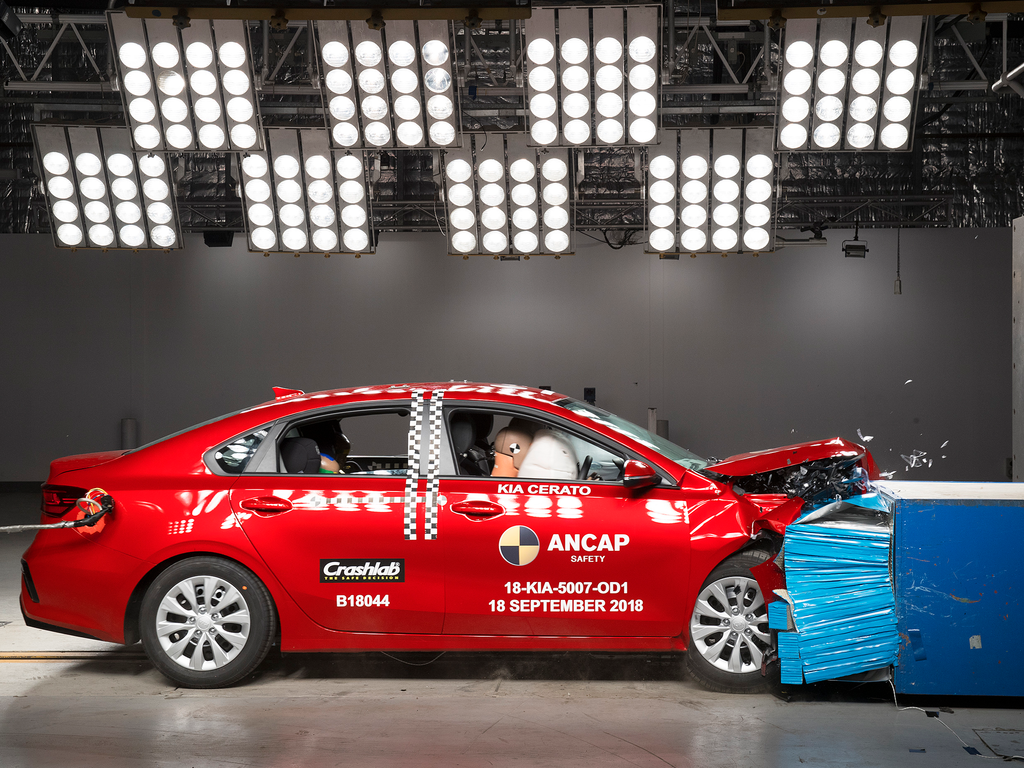
The Kia Cerato was given a split four-star and five-star rating across its model range by ANCAP in January for models excluding and including AEB, which at the time Goodwin said meant consumers of the popular family and business fleet hatch and sedan had to pick carefully.
“All variants offer autonomous emergency braking (AEB) and lane support functionality, however the AEB system fitted to S and Sport variants offers reduced performance,” Goodwin said in January.
“Kia should be commended for offering an affordable vehicle which meets today’s demanding five-star requirements and we would recommend consumers opt for a five-star variant as they provide added safety benefit to all road users,” he said.
“We strongly encourage vehicles which offer collision avoidance technologies like AEB, however it’s important consumers are aware there can be differences in performance across brands, models and variants,” he added.


Join the conversation